North Texas is a beautiful place to put down roots. The neighborhoods around Bedford, Arlington, and the wider DFW Metroplex offer great schools, strong community ties, and a housing market with real opportunity. But underneath every slab, every front porch, and every driveway, there is something working against you — and it never stops.
North Texas clay soil is some of the most expansive in the entire United States. It swells when it rains. It shrinks when it bakes. And in a region where rainfall can swing dramatically between seasons, that cycle never truly ends. If you are buying a home here and you are not thinking about what the soil is doing to the foundation, you could be walking into one of the most expensive surprises in real estate.
As a home inspector serving Bedford, Arlington, and surrounding DFW communities, I want to walk you through what you really need to know before you close.
What Is Expansive Clay Soil and Why Does It Matter?
Expansive clay is a type of soil that absorbs water and physically swells in volume — then contracts as it dries out. Some soils barely move at all when moisture levels change. Clay soil in North Texas moves a lot.
When this expansion and contraction happens under a concrete slab foundation, it creates uneven pressure from below. Parts of the slab may be pushed upward. Other sections may settle downward as the soil dries out and pulls away. Over months and years, this uneven movement creates stress throughout the structure — in the slab itself, in the framing above it, and in everything attached to the house.
This is not a fringe concern in North Texas. It is one of the defining characteristics of building and buying here. Knowing that going in puts you in a much better position than learning about it after closing.
Key takeaway: If you are buying a home in Bedford or anywhere in the DFW area, soil movement is not a question of if — it is a question of how much, and what it has already done to the house you are considering.
How Does Clay Soil Affect Foundations in Bedford and Arlington TX?
The effect on foundations depends on how much the soil has moved, how consistently it has moved, and whether the drainage around the home manages moisture well. Here is what I see regularly in this market:
Slab foundations — the most common type in North Texas — are designed to flex a bit, but they have limits. When soil movement is significant and uneven, slabs crack, tilt, and shift. Corner pops (cracks at the corners of the slab) are common. Interior cracks across the slab surface often follow. In more significant cases, you will see the slab lifting on one side while settling on another.
Pier and beam foundations — found frequently in older Bedford and Arlington homes — have their own set of vulnerabilities. The crawl space environment under a pier and beam home can trap moisture, which accelerates wood deterioration, introduces pest activity, and creates conditions that accelerate the effects of soil movement on the beams and piers themselves. Older homes in this area with pier and beam construction warrant close attention.
Drainage is the single biggest factor that determines how quickly clay soil movement becomes a problem. Poor grading around the foundation, overflowing gutters, or landscaping that directs water toward the house instead of away from it all accelerate the cycle.
Key takeaway: Soil movement affects slab and pier-and-beam foundations differently, but both types warrant a careful foundation inspection in this market. A good inspection looks at what has already happened, not just what might happen.
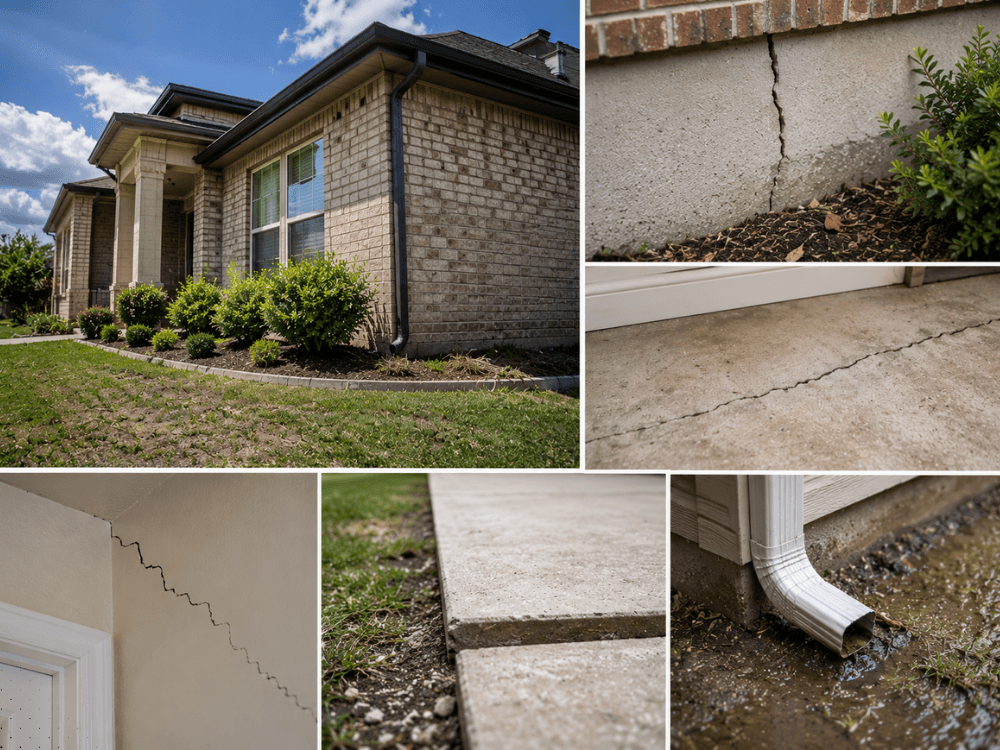
What Signs of Foundation Movement Should Buyers Look For?
During a pre-purchase inspection, I walk through both the structure and the site looking for evidence of movement. Here are the signs I document most often on DFW homes:
Inside the home:
- Doors and windows that stick, drag, or no longer close properly
- Cracks in drywall — especially diagonal cracks running from the corners of door frames and window openings
- Gaps between the wall and ceiling, or between the floor and wall trim
- Floors that feel noticeably sloped or uneven when you walk them
- Cracks in tile floors, particularly in diagonal patterns
Outside the home:
- Cracks in the brick veneer, especially stair-step cracks following the mortar joints
- Gaps between the brick and any door or window trim
- The slab edge visibly higher on one side of the home than another
- Poor drainage — soil sloping toward the foundation, saturated ground near the perimeter
One important note: not every crack is a sign of major structural movement. Small shrinkage cracks are common and often cosmetic. The pattern, location, width, and direction of cracks tell the real story. That interpretation is part of what a trained inspector brings to the table.
Key takeaway: Look for the patterns, not just individual cracks. Multiple signs pointing in the same direction — especially at door frames, corners, and the exterior brick — are what warrant close attention.
What Is a Foundation Elevation Measurement and Do I Need One?
A standard home inspection includes a thorough visual assessment of the foundation and structure. But for buyers who want actual data on how much the slab has moved — not just what it looks like — a foundation elevation measurement is worth serious consideration.
A foundation elevation measurement uses a zip level or similar instrument to take precise readings at multiple points across the slab. Those readings map out the actual elevation of the floor at each location, identifying where the slab is high, where it is low, and by how much.
This data is especially useful when:
- The home shows multiple signs of movement and you want to understand the severity
- You are negotiating repairs with the seller and need documentation
- A structural engineer or foundation contractor is being brought in for a second opinion
- You want a clear baseline to compare against at a future date
Foundation elevation measurements are a separate add-on from a standard inspection. I offer them for clients who want that next level of documentation before making one of the biggest financial decisions of their lives.
Key takeaway: Visual inspection tells you what is there. Elevation measurement tells you how much it has moved. For a home showing significant signs of foundation movement, that data is worth having before you close.
How Do I Get a Foundation Inspection in Bedford TX?
I am Jantson McAffrey, the owner and inspector at Surety Home Inspections LLC in Bedford, TX. I am InterNACHI-Certified (CPI) and licensed under TREC #26094, which means every inspection I perform meets the standards set by the Texas Real Estate Commission.
When I inspect a home, I look at the foundation as part of a complete structural assessment — not as a checkbox. I walk the perimeter, I look at every visible crack, I evaluate drainage and grading, I examine how doors and windows are behaving, and I document what I find in a clear report you can actually use.
If you are buying a home in Bedford, Arlington, Hurst, Euless, or anywhere in the greater DFW area, I am here to make sure you know what you are buying before you sign.
Ready to schedule your inspection? Book online at suretyinspector.com/schedule-now/ or call and text me directly at (806) 674-6798. I will make sure you have the information you need before you close.

Frequently Asked Questions About Foundation Issues in Bedford, TX
Does North Texas clay soil cause foundation problems?
North Texas clay soil can expand when it absorbs moisture and shrink during dry weather. These changes may create uneven pressure beneath a home’s foundation. Soil alone does not confirm a foundation problem, but it can contribute to movement over time.
What are common signs of foundation issues in a Bedford home?
Common signs may include wall cracks, brick separation, sticking doors, sloping floors, gaps near windows, and soil pulling away from the slab. One sign may not indicate a major concern. Inspectors look for patterns across the property.
Can a home inspection confirm foundation failure?
A standard home inspection cannot confirm structural failure. It is a visual review of accessible systems and components. The inspector may document signs of movement and recommend further evaluation by a structural engineer when needed.
Are foundation elevation measurements useful before buying a home?
Foundation elevation measurements can document relative floor-height differences across accessible areas. These readings may provide useful context when combined with cracks, sloping floors, sticking doors, or other visible conditions. Measurements do not diagnose foundation failure by themselves.
Are foundation cracks always a reason to avoid buying a home?
No. Many homes have minor cracks caused by normal settlement, material movement, or age. Buyers should consider the crack’s location, width, pattern, and nearby conditions. A professional inspection can help determine whether more evaluation is recommended.
How can Bedford homeowners reduce soil-related foundation movement?
Homeowners can maintain gutters, direct runoff away from the house, repair plumbing leaks, monitor grading, and limit sharp moisture changes around the foundation. Property-specific advice should come from a qualified local professional.
North Texas clay soil deserves attention, but it is only one part of the property.
Roofing, HVAC, plumbing, electrical systems, attic conditions, drainage, and exterior components may also affect your buying decision.
Surety Home Inspections evaluates visible and accessible systems and explains the findings in clear terms.
To schedule a home inspection in Bedford, schedule online or call or text Surety Home Inspections at (806) 674-6798